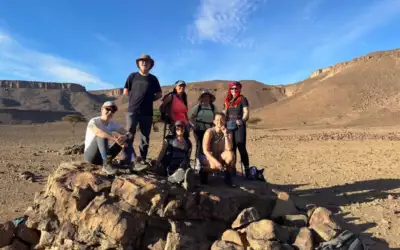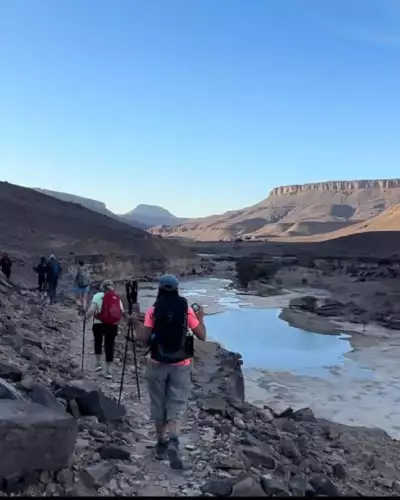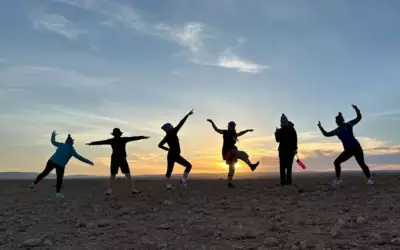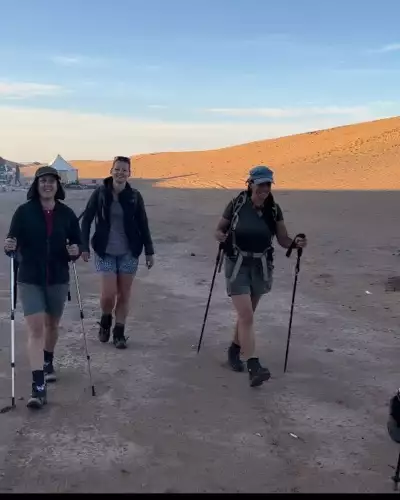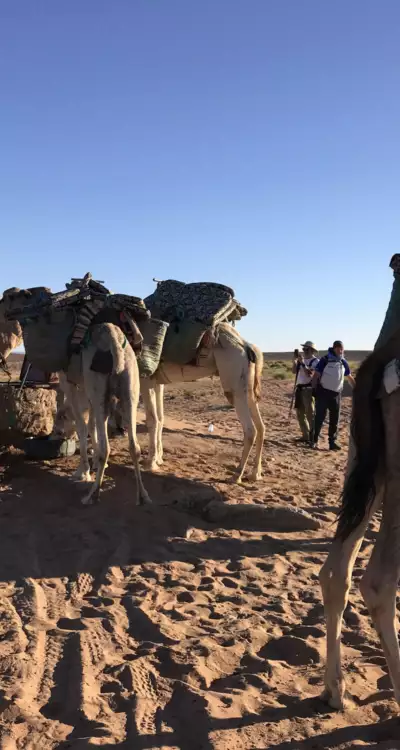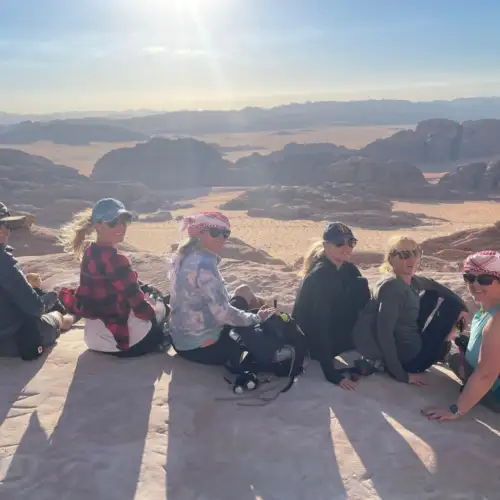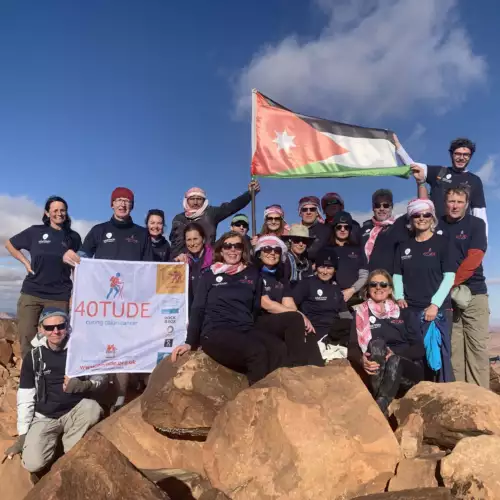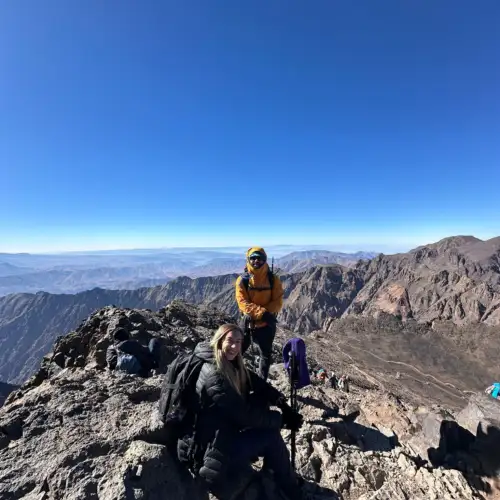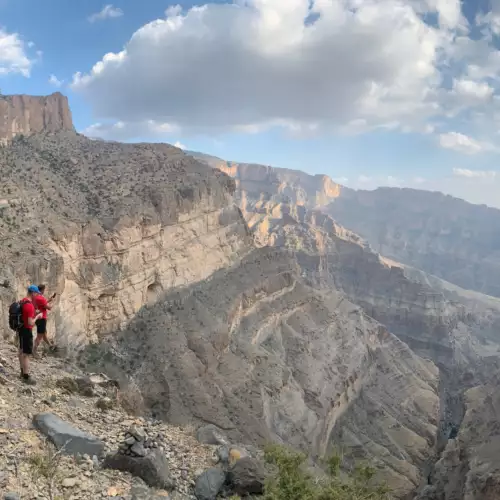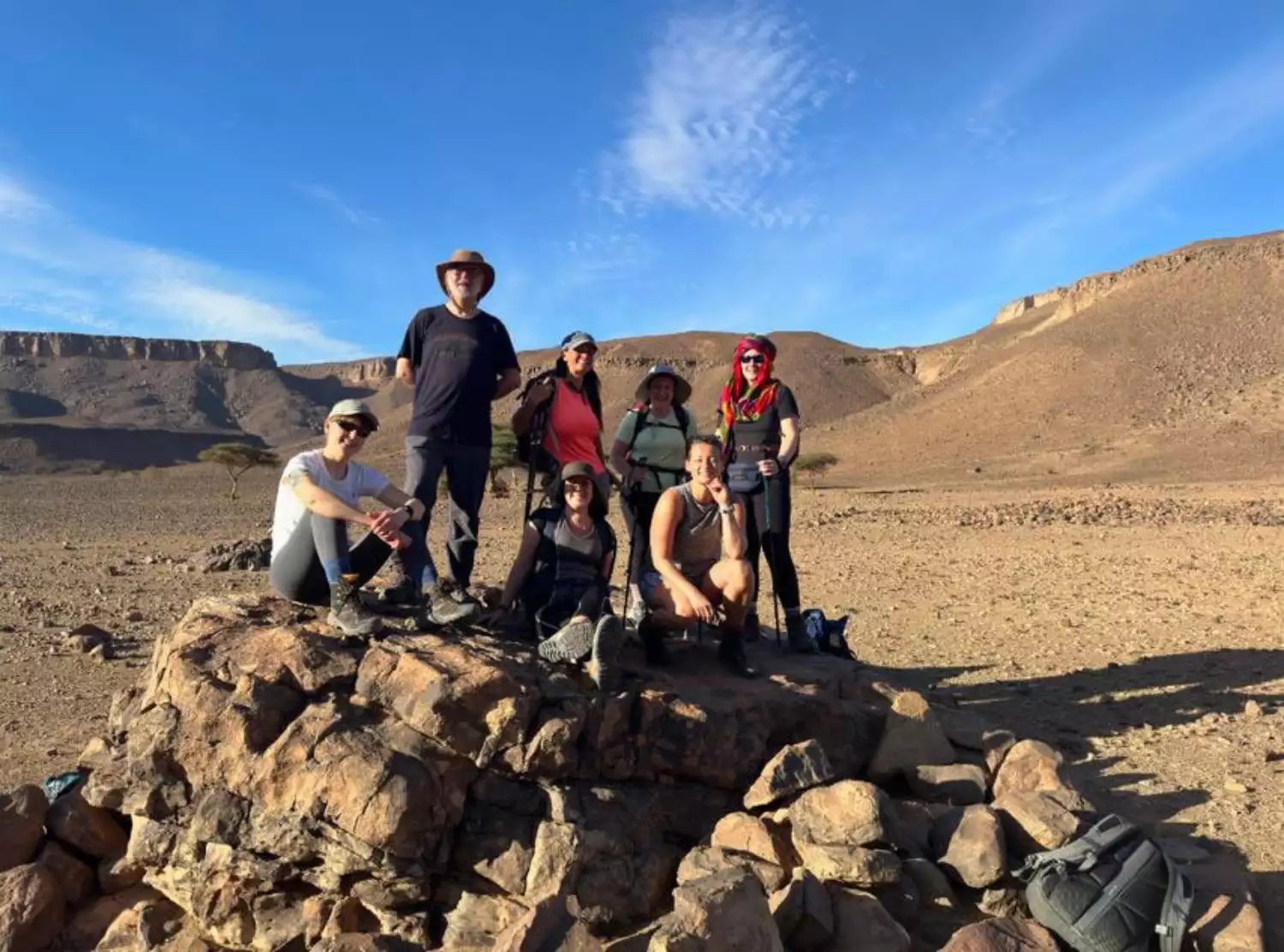
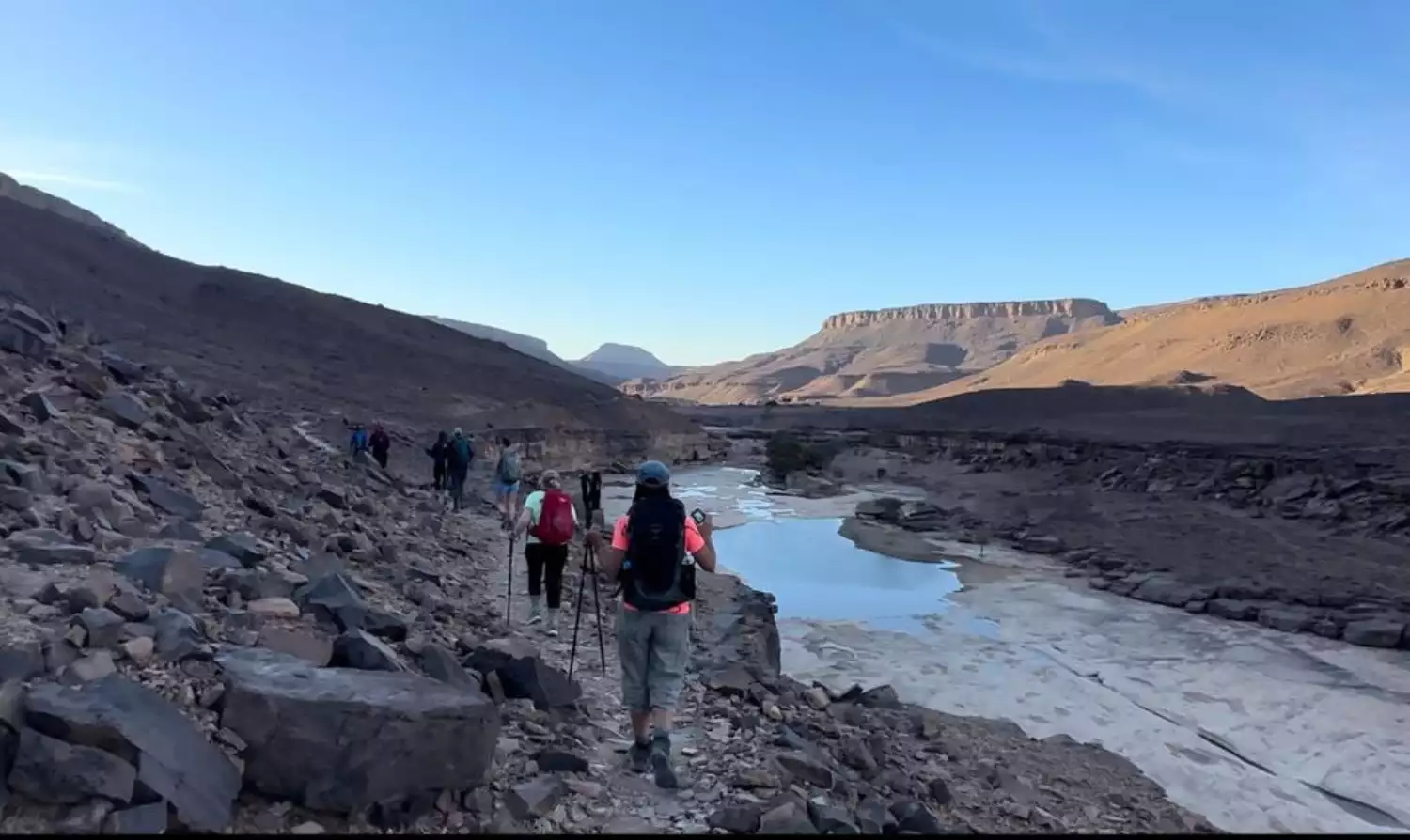
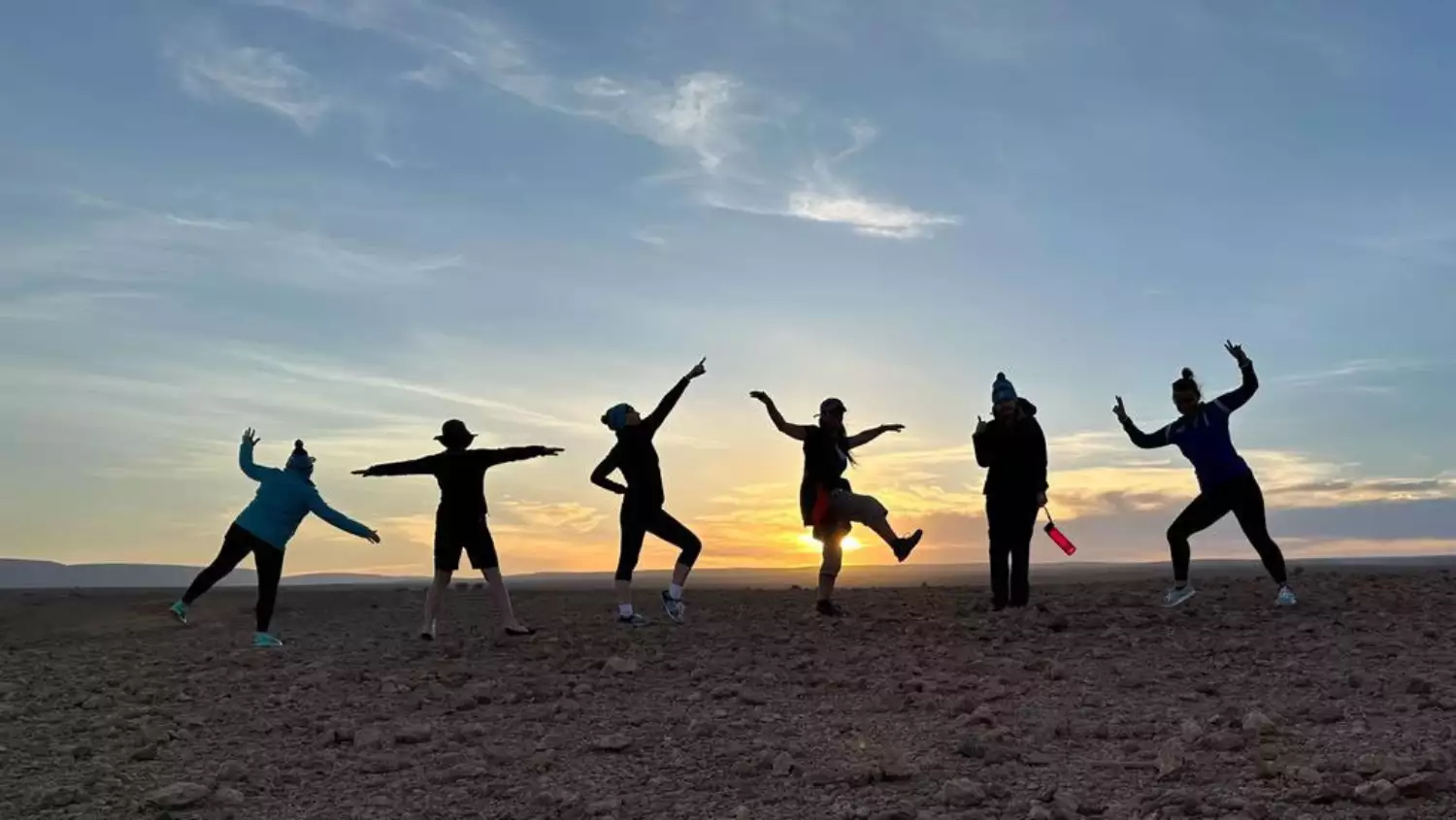
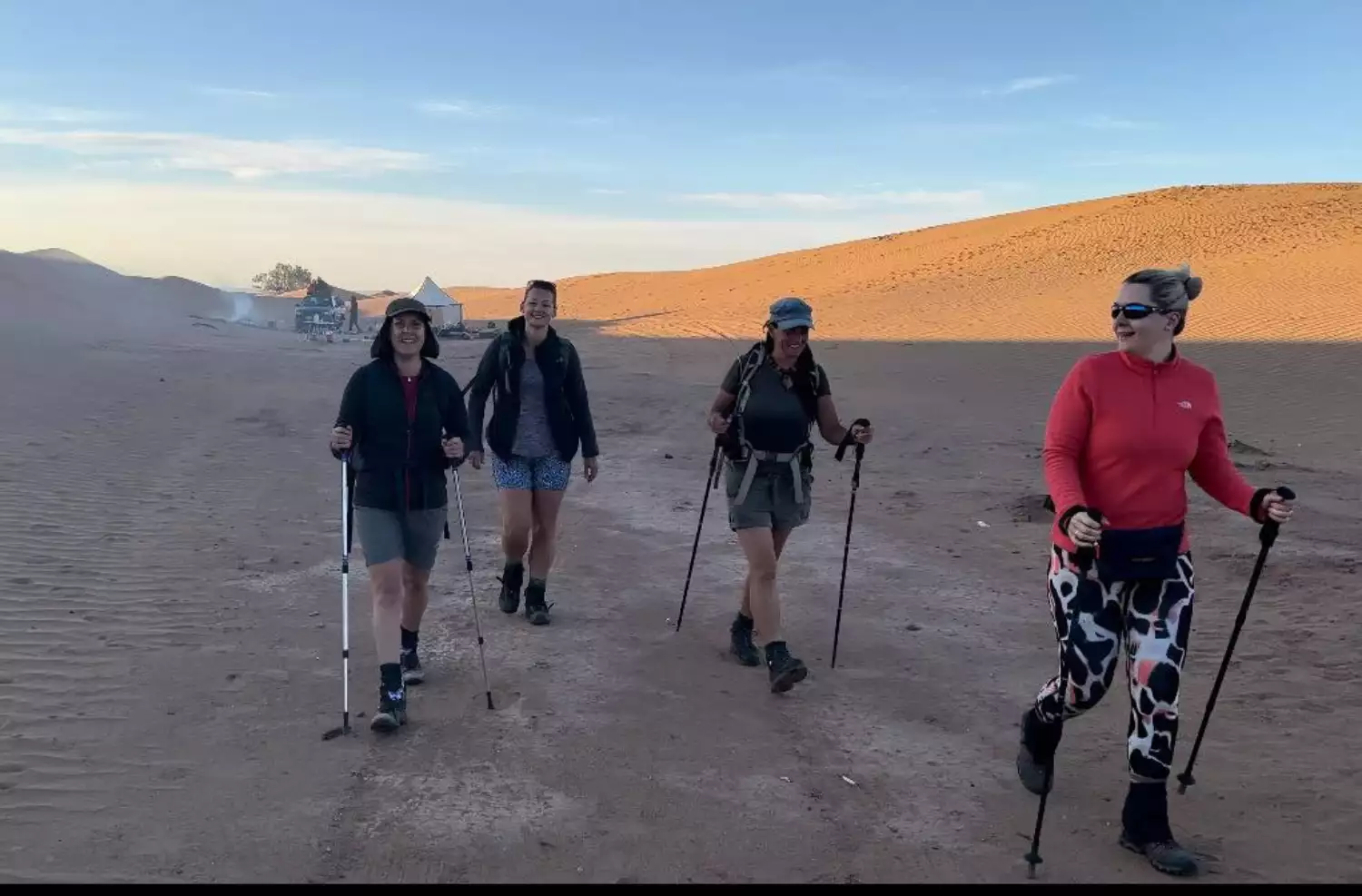
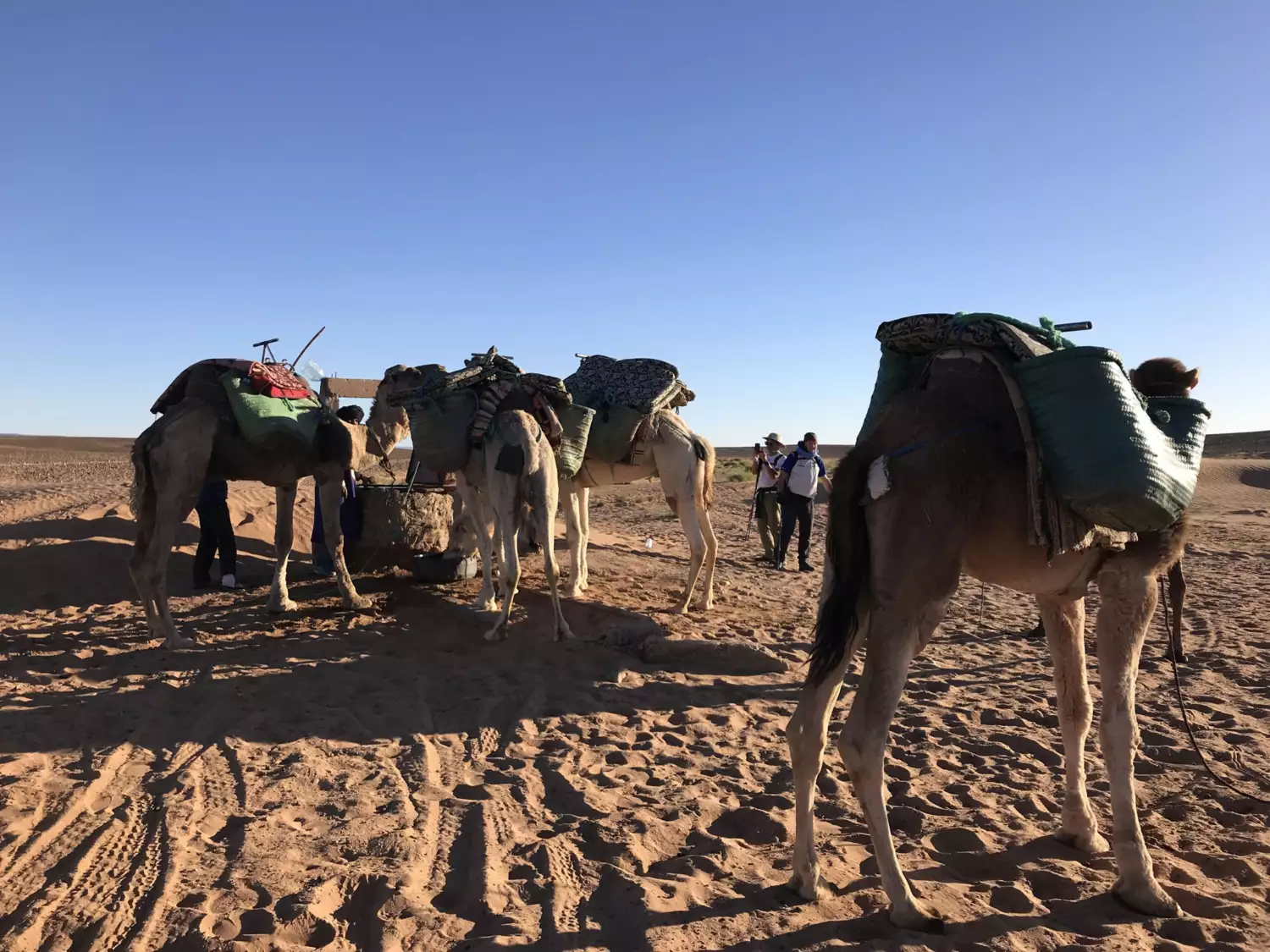
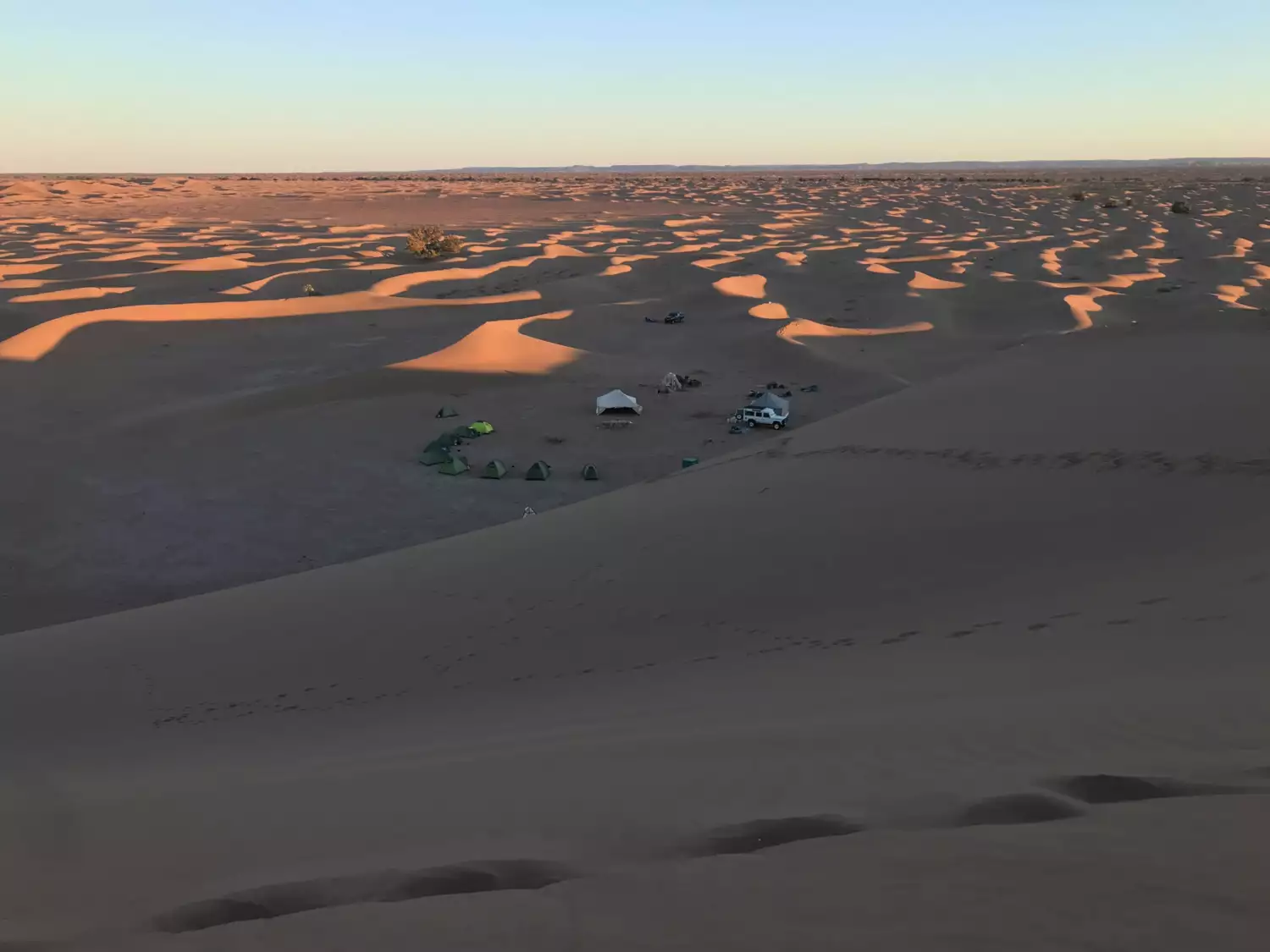
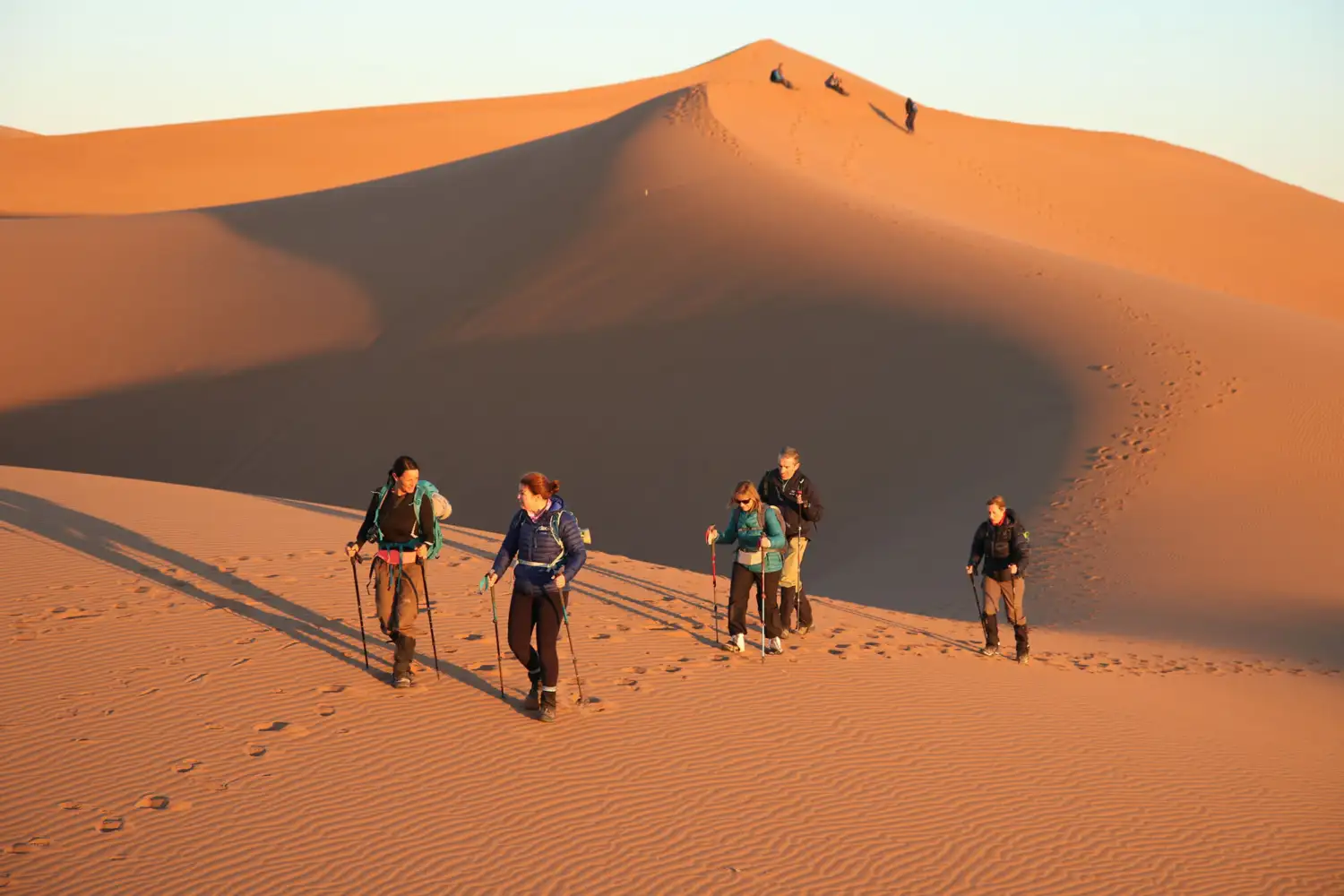
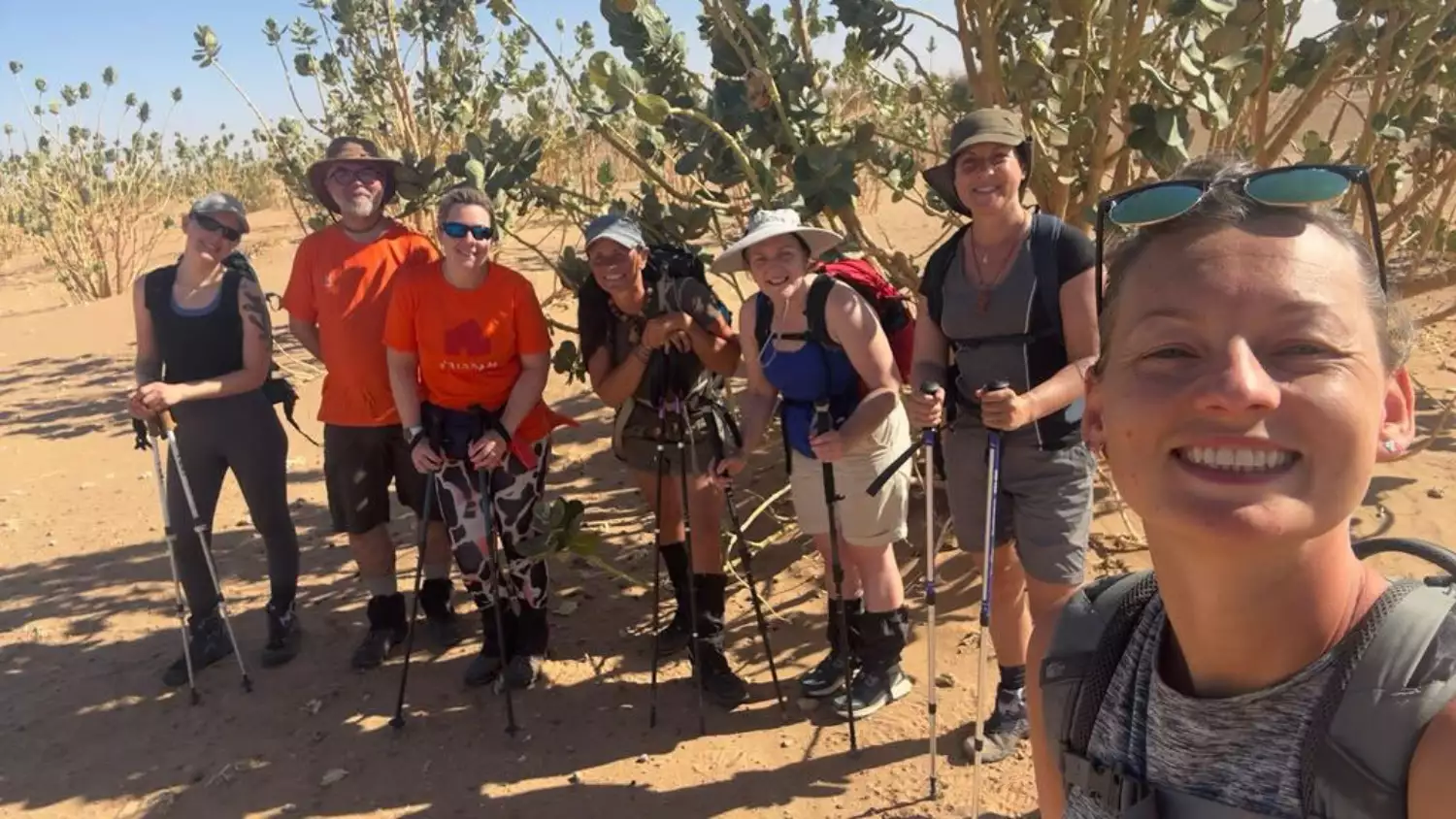
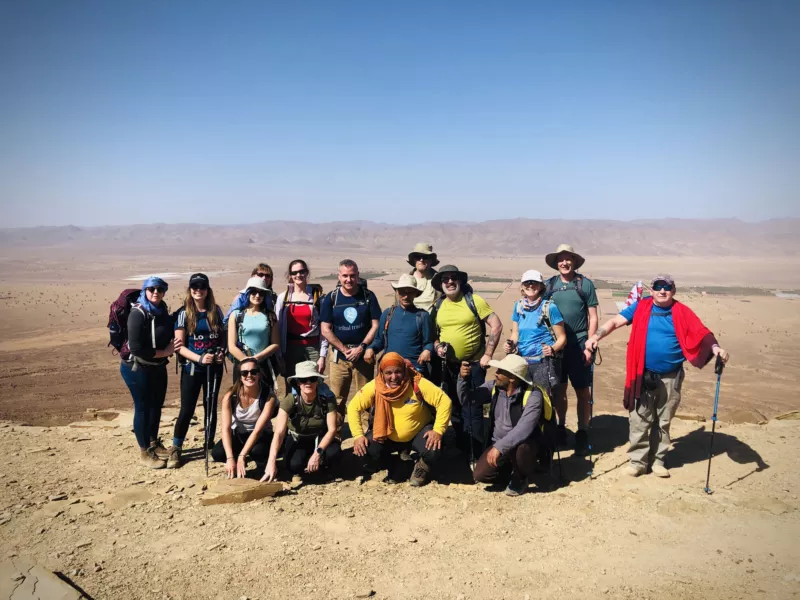
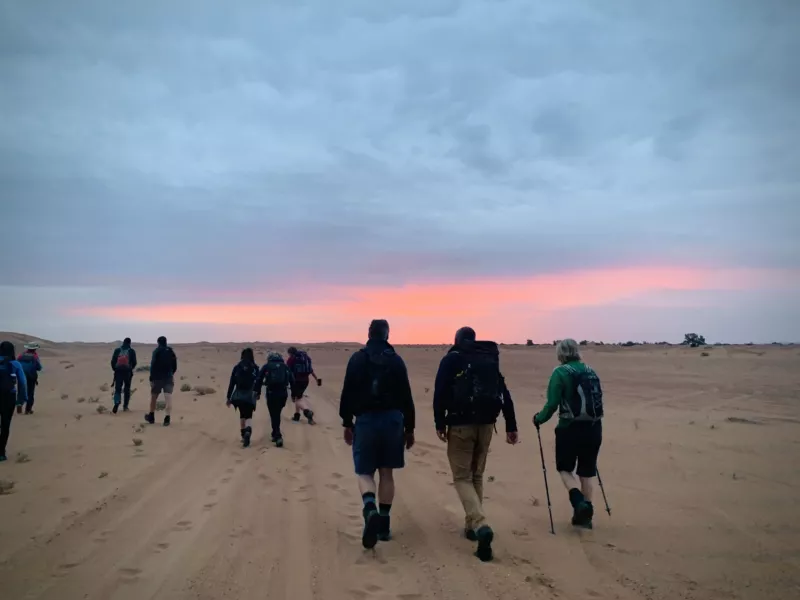
A fantastic experience walking with an inspirational group of people. All against the desert in difficult conditions. We all pushed through to the finish. That is a great feeling!
David C, 2023
Location
Terrain
Difficulty
Accommodation and Meals
Hotel, Desert Wild Camping
Duration
9 days
Meeting Point
Marrakech
Annual Leave
7 days
Group Size
Up to 20
Seasons
November to March
Walking Distance
100km
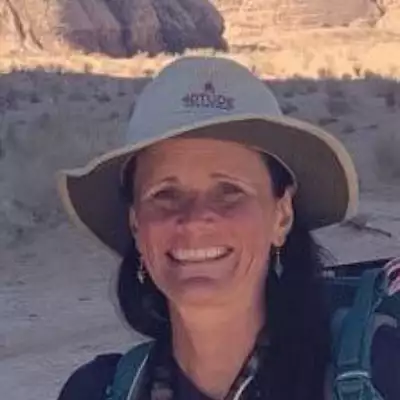
Lynsey is requested time and time again by our repeat trekkers. She is a full time mountain leader based in the North East of England.
Trek 100km through the varied terrain of the Sahara desert, accompanied by camels.
Wild camp in spectacular locations, under vast, starry African skies.
Visit the Amnougar Project in Ouarzazate
Toast your achievement in Ait Ben Haddou, the setting for 'Gladiator', where you will stay in a unique hotel and enjoy a celebration meal.
Explore the exotic city of Marrakech
All the info you need
Trip Details
Desert mountains. Stony plateau, oases full of date palms, beautiful, sculpted dry Wadis.
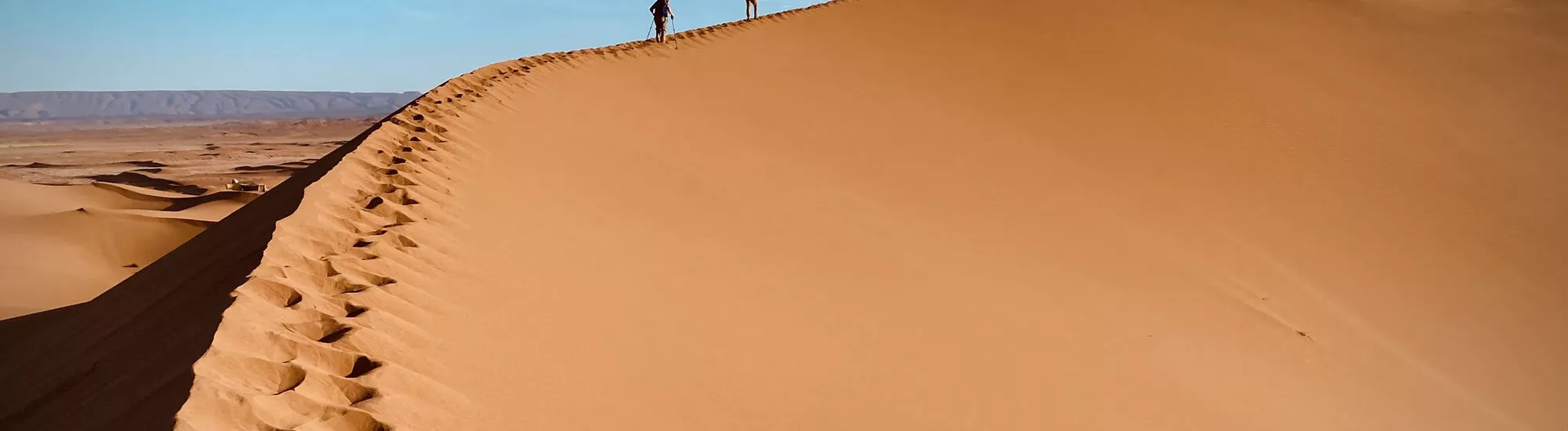
Dusky orange dunes rolling away towards the heart of Africa. Camping under huge African skies at night, by day we trek with camels, experiencing 100km of the varied desert terrain. We also visit Amnougar in Ouarzazate (read more about this on day 2 of the itinerary!)
Trip Details

The adventure begins when you meet your Tribal Tracks leader on arrival at the airport in Marrakech, and this is also where we will meet our local guides.
As we'll all be arriving at different times, we will spend the day in Marrakech today. Depending on your flight time, you are free to explore.
Accommodation and Meals
Overnight in twin / double share rooms in Marrakech, dinner.
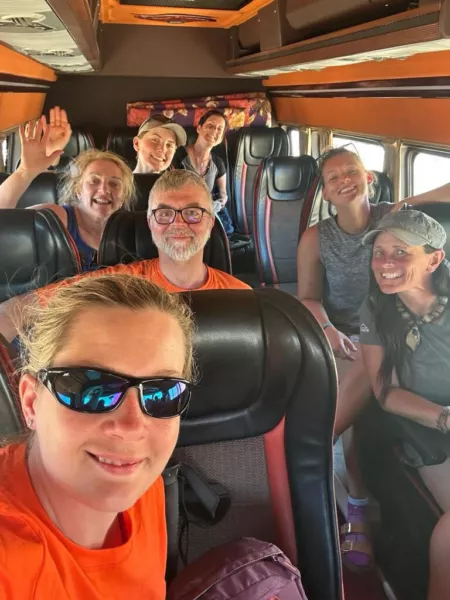
We begin our journey to the Sahara desert and head to Ouarzazate.
We transfer to the desert via Tichka Pass, the highest and most beautiful road pass in Morocco, to the south of Morocco, past Ait Ben Haddou and onto Ouarzazate to visit Amnougar.
Amnougar is a transformative project based in Ouarzazate, dedicated to supporting young adults with disabilities from across Morocco. The initiative offers five vocational apprenticeships in farming, carpentry, sewing, jewellery making, and cooking. On completion of their training, apprentices receive officially recognised certificates from the Moroccan State, equipping them for employment or the opportunity to establish their own businesses.
With 18 full-time staff, Amnougar provides food and lodging for its students throughout their training. At any given time, the centre supports an average of 30 apprentices. In Morocco, individuals with disabilities can face exclusion based societal/religious beliefs. Amnougar is actively challenging this stigma by empowering young adults with valuable skills and paving the way for a brighter future. The team will have the opportunity to meet the apprentices, join them for a 2-course lunch cooked by the apprentices and gain insight into the various skills they are mastering.
Later, we return to our hotel and have a pre-trek briefing, ready for the next day and the start of our trek.
Accommodation and Meals
Overnight in twin / double share rooms in Ouarzazate, lunch, dinner.
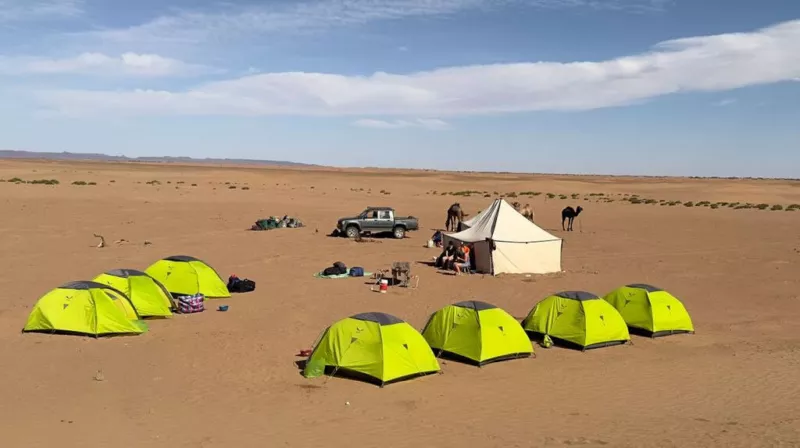
After an early start we transfer to the start of our trek at Faija where we will have an early lunch and meet our support crew, camels and cameleers.
Lunch is in a truly spectacular setting, looking up towards the tizi, the pass we are heading towards. We begin trekking, and with numerous switchbacks, we tackle the only real elevation on the trek, but are rewarded with fantastic views across the valley towards Zagoura. We trek through Jebel Bani, Col Umm Laachar, past the oasis of Amda Noumssafi and then find our first camp, next to a dry Wadi. We will follow this Wadi the next day, but for now, we can take a break, and enjoy a fantastic, freshly prepared dinner, while looking up at the starry night sky.
5-6 hours trekking, 15 km.
Accommodation and Meals
Overnight wild camping in twin tents, full board.
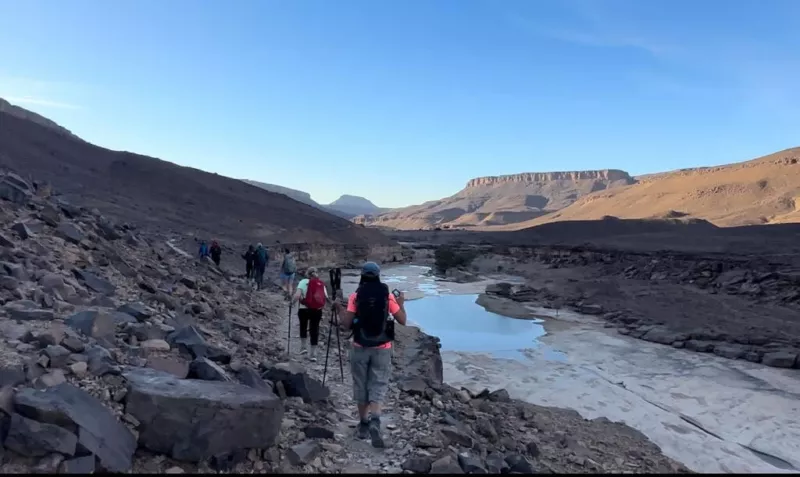
Passing by Lmhasser, we will set out along a dry riverbed taking us out towards the desert sands.
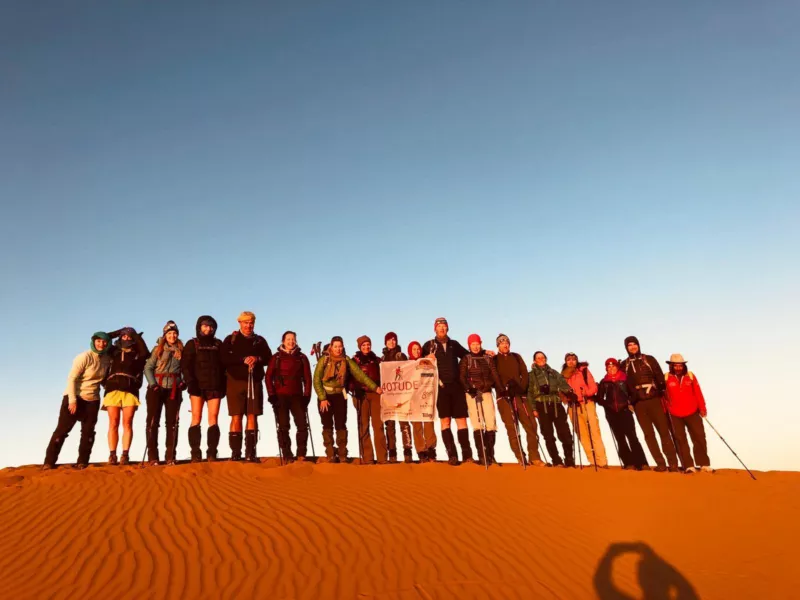
We will pass by a nomad camp, and if the family are there, we can stop and visit, and find out a little about their way of life. We will have lunch shortly after this, in the shade of a small copse of squat desert trees. After lunch, we trek over rocky plateau, and just after El Abbes, we head to the dunes of Chegaga where we will find our camp for the night. We can climb the dune behind our camp for sunset, and revel in the amazing views of the dunes rolling away towards the Algerian border and towards the heart of Africa.
Today will be our longest and toughest day, you will need to dig deep, but seeing the deep red dunes of Chegaga for the first time is truly unforgettable experience.
9-10 hours trekking, 32 - 34km.
Accommodation and Meals
Overnight wild camping in twin tents, full board.
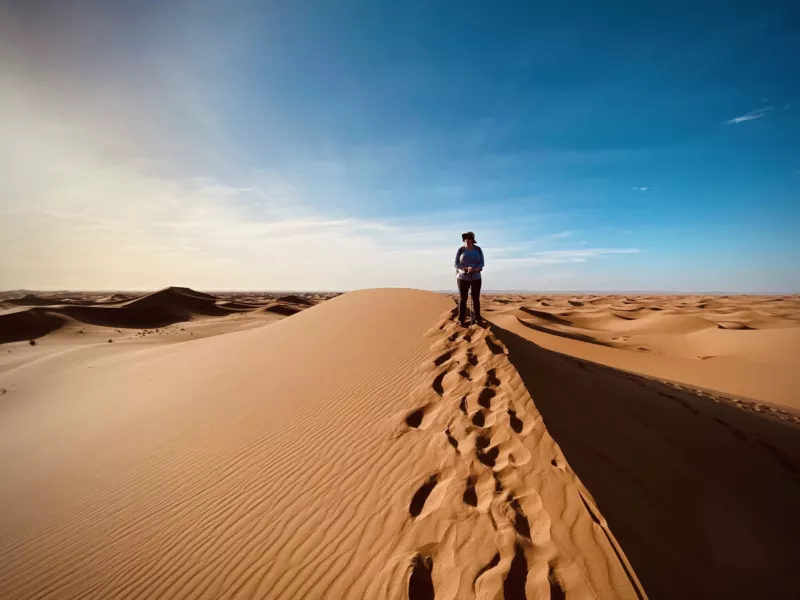
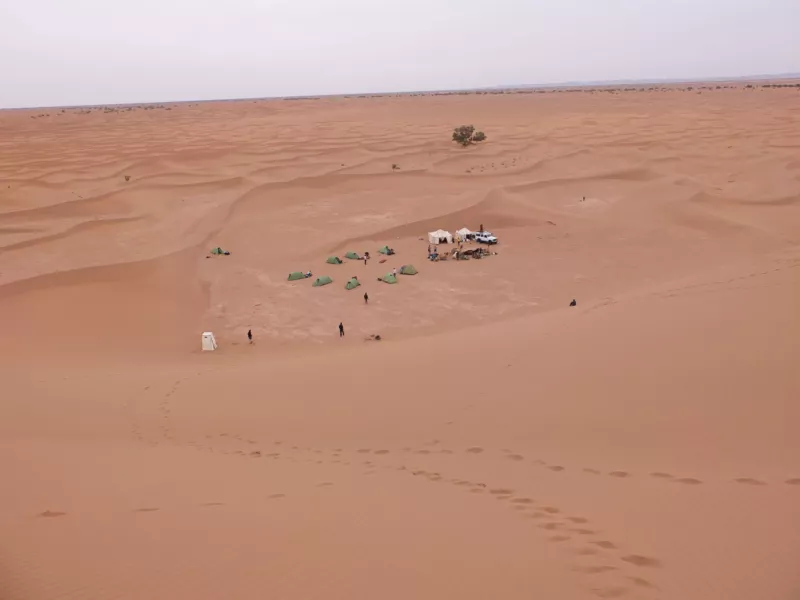
Today is a spectacular day.
Rising before dawn, we begin trekking under the clear desert skies, watching the colours of the dunes change as the sun comes up. We have fun in the dunes before trekking out of them, towards the direction of M’Hamid and Oued Draa.
We will have lunch under the trees at Tamarist and then head on to the dunes of Bougarn. Today will be tough on the feet as we trek over hard, rocky terrain and hot sand in the afternoon!
7-8 hours trekking, 24km.
Accommodation and Meals
Overnight wild camping in twin tents, full board.
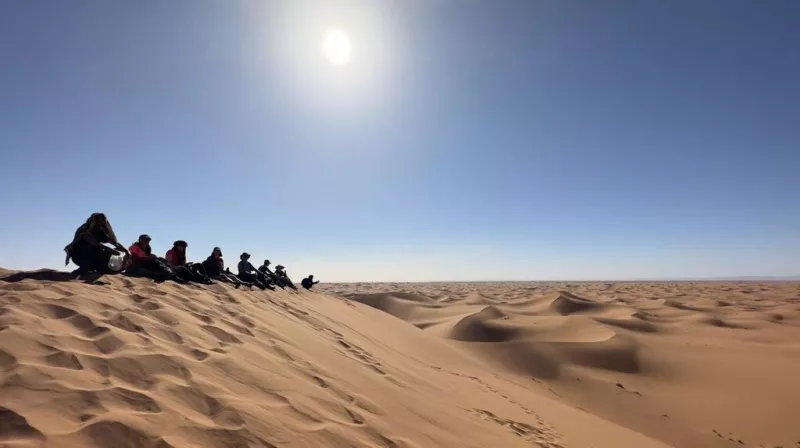
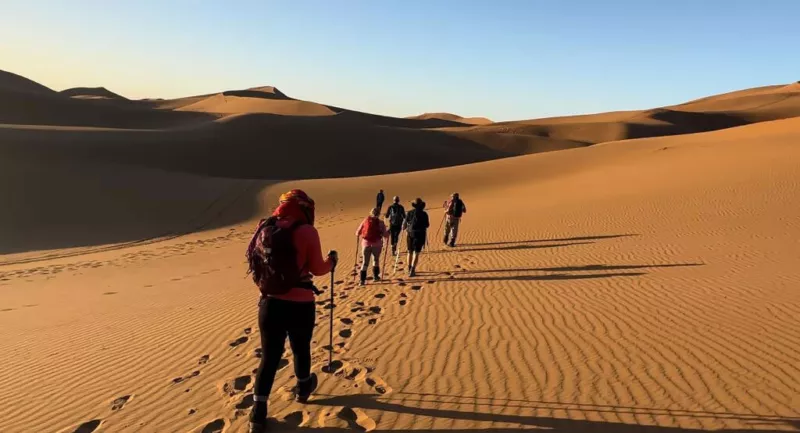
We have another early start so that we can appreciate a spectacular desert morning and make the most of the cooler temperatures.
The low shrubs, small dunes, Tamarist trees and desert acacia create a wonderful atmosphere as the sun rises in the east. We will then head out across the dunes and the stony desert plain to camp at Oued Naam for the evening. This will be our last wild camp and the setting does not disappoint. There may be some dancing and bread making this evening!
7-8 hours trekking, 22km.
Accommodation and Meals
Overnight wild camping in twin tents, full board.
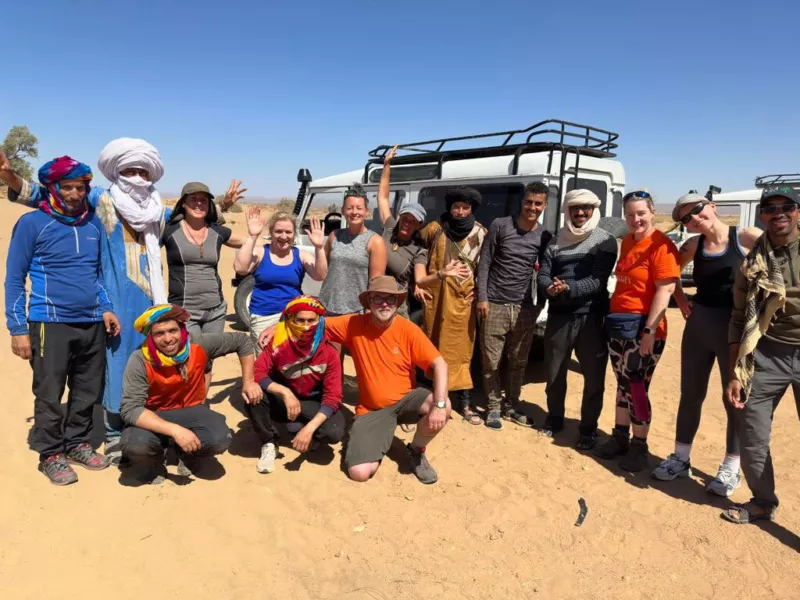
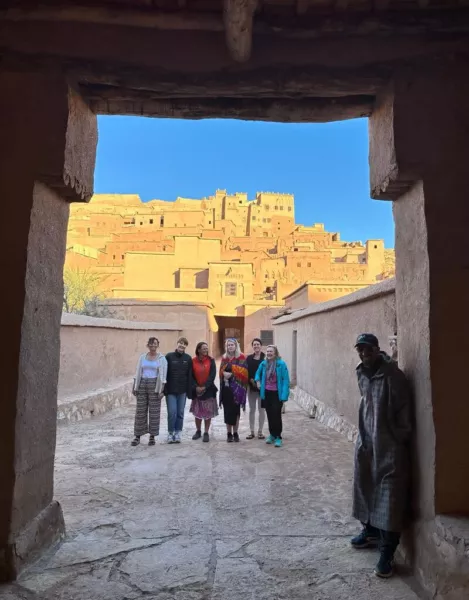
On the final day of your challenge, we head towards M’Hamid, traversing some mini dunes before ending our trek in a beautiful setting, back in the ‘big dunes’, for a celebration lunch.
We will take a well-earned rest before saying a sad goodbye to our amazing crew, before being transferred to Ait Ben Haddou, after a jeep ride out of the desert. Tonight we can celebrate our achievements by letting our hair down after a celebration meal.
3-5 hours trekking, 14km, 3.5 hour transfer to Ait Ben Haddou.
Accommodation and Meals
Overnight 4 Star hotel in Ait Ben Haddou, full board.
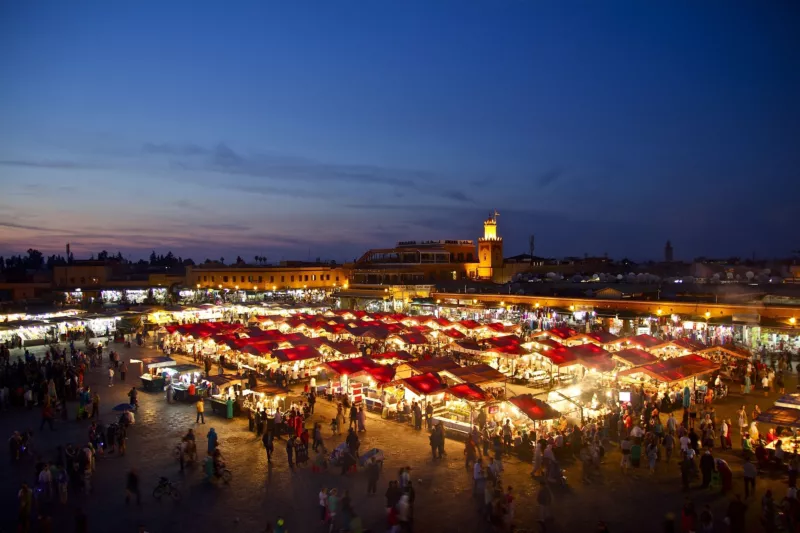
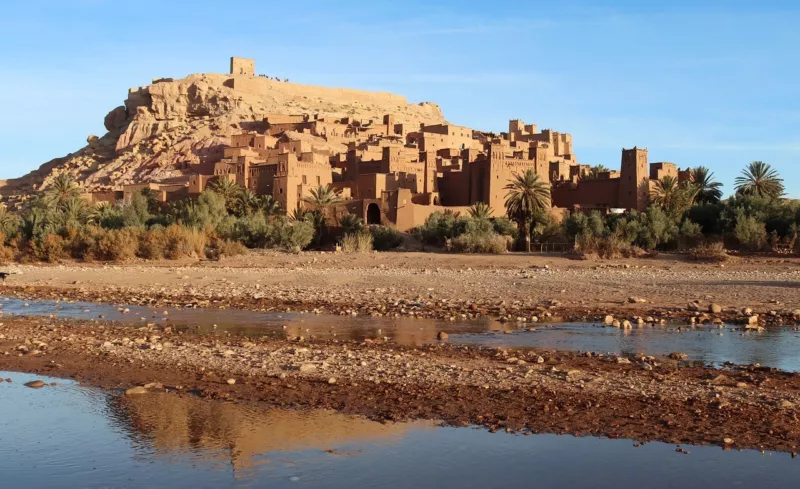
After breakfast we will begin our transfer back to Marrakech, enjoying the varied scenery over the High Atlas passes.
We will have time to explore the UNESCO World Heritage Site of Ksar Ait Ben Haddou before we return to Marrakech. The ksar, a group of earthen buildings surrounded by high walls, is a traditional pre-Saharan habitat. The houses crowd together within the defensive walls, which are reinforced by corner towers. Ait-Ben-Haddou, in Ouarzazate province, is a striking example of the architecture of southern Morocco. We will transfer back to Marrakech in time for a late lunch and some time to explore the souks and the main square. After settling into our hotel, you can enjoy a night in Marrakech with dinner in a local restaurant.
Accommodation and Meals
Breakfast, lunch, dinner, Riad in Marrakech
It is time to say farewell after our amazing Sahara adventure.
After breakfast, we will transfer to the airport for your flight home
Accommodation and Meals
Breakfast
Trip Details
Trip Details
This is what you will need to pay for/ buy/source yourself.
In a nutshell, almost everything!
This is what you will need to buy/source yourself.
Tribal Tracks has 100% Financial Protection and has a trust account with the Protected Trust Service, member number 5566.
This means that all client monies paid to Tribal Tracks are held in our dedicated trust account, which is supervised by an independent trustee. This means that in the very unlikely event that Tribal Tracks ceases to trade, your money is safe. For more information, please visit this link. Any flights booked for you by Tribal Tracks will be ATOL-protected under our own ATOL certificate.
In setting the maximum size of our groups, we take a number of factors into account.
Altitude, degree of difficulty, the terrain, the climate and time of year, all determine the maximum group size. Sometimes it will be 20, sometimes it will be 8-14, but safety is always our priority.
You will be accompanied by a Mountain Leader qualified Tribal Tracks UK Leader as well as supported by our local, in-country guides. If you are travelling with a charity team, someone from the charity will likely accompany the group too.
If your flights are included in the trip price you will automatically be booked on to the same flights as everyone else in the team, unless you let us know before or on booking. If you want to book your own flights, you need to ensure that you coordinate your arrival and departure times with the trip’s itinerary. If your dates/timings don’t align with the itinerary, you will be responsible for costs incurred for additional airport transfers or accommodation arrangements.
Tribal Tracks can book alternative flights for you (for example, from a different departure airport) but this may incur an extra charge. We will liaise with you about costs before booking to ensure you’re happy to proceed.
It is really important that you are well prepared for your physical challenge and that you are confident that you will be able to fully participate.
Although our leaders are well trained to deal with different capabilities, if they have any concerns about someone’s ability to safely partake in the trek, or their impact on other people’s enjoyment, we authorise them to take necessary action which, in some circumstances, may involve asking someone to step out of the trek. Although this is a very rare occurrence, by booking this trip you agree to section 11 of our Booking Conditions which clearly states that our leaders have the authority to do this. In these circumstances, we will ensure anyone sitting out is safely provided for and offered alternative options where possible. Refunds will not be provided for activities missed and customers may be liable for additional costs incurred.
Please check the most recent FCDO advice.
Typically, to enter Morocco, your passport must have an ‘expiry date’ at least 3 months after your arrival. You can visit Morocco without a visa for up to 90 days for tourism.
Please be advised that if you do need a visa (for example, if you're traveling on a South African passport), we advise starting the process as early as possible. Their visa processing system has been slow and difficult to communicate with. We recommend using a service like Coast to Coast visas to help, email Peter at info@c2cvisas.co.za and mention your Tribal Tracks itinerary.
It is a requirement of Tribal Tracks booking terms and conditions that each supporter must hold their own travel insurance, which covers the trip and the activities they are doing. Read more here.
We advise you to put insurance in place as soon as possible, ideally on booking so you are covered immediately. There have been instances where someone has signed up, broken their leg a few weeks later, and been deemed unfit to travel. If travel insurance were in place, the non-refundable deposit could be claimed back from the insurance policy. Without this, your money is lost.
Your insurance must be valid and in date, covering the entire period that you are travelling for, including the return journey home. It must cover medical and personal accident risks, and should include repatriation costs and air ambulance or helicopter rescue services, where appropriate.
We will need to know the travel insurance provider, your policy number and the 24 hour medical/emergency assistance number.
Please inform us of any dietary requirements or allergies before you travel, and preferably at the time of booking and no later than 4 weeks prior to departure. We can cater to almost any diet, but only if we know about it beforehand.
For up-to-date vaccination information, please visit Travel Health Pro to see the most recent recommendations for your itinerary.
Although we are travel experts, we are not medical specialists, so we cannot explicitly recommend what vaccinations you should or shouldn't have. Always seek the advice of a medical professional if you are unsure. They will likely want to see a copy of your itinerary, and can then best advise whether they think an advised or 'to consider' vaccination is appropriate for you.
Please note that information on vaccinations can change at short notice.
At Tribal Tracks, Responsible Travel is enormously important to us, and our commitment to responsible travel is evidenced in every itinerary that we prepare.
Core to our business is the belief that holidays can and should be enjoyable to the traveller but should be conducted in a socially, environmentally and economically responsible manner which brings benefit to local communities. This is implemented through a variety of measures which can be found in our Responsible Travel policy. We encourage you to read this and to play your own part in travelling responsibly.
The Foreign, Commonwealth & Development Office (FCDO) monitors all overseas destinations and offers advice to British citizens. In order to be fully informed of safety issues, crime rates, political stability and local laws and customs, you can view the advice here.
We monitor FCDO advice carefully and may, on occasion, be required to cancel trips, reroute itineraries, or make other changes to trips based on the FCDO advice. Any decision will always be made in your best interests and fully communicated to you.
Tribal Tracks considers the safety of all of its participants and staff to be a top priority, and as such we have thorough safety systems in place.
In the event of an injury, we have an evacuation plan in place for all elements of the trek route. We do ask that you look after yourself during the trek in the following way, as this will help avoid unnecessary problems:
It is always important to have precautions in place to avoid heat-related illnesses that can spoil your day or adventure. Click here to find a couple of tips to help you stay safe and comfortable.
In many tropical countries, mosquitoes can spread diseases such as Dengue, Chikungunya, West Nile Virus, Malaria, Yellow Fever, and Zika virus. It is essential that you seek medical advice prior to travel, and especially if you are pregnant or have an underlying medical condition. Whilst travelling there are several simple measures you can take to reduce your risk of infections spread by mosquitoes: wear suitable clothing and cover up at times of day when mosquitoes are active, use insect repellent on exposed skin (containing 20% to 30% DEET), and use a mosquito net if sleeping in unscreened accommodation.
It is important to seek prompt medical attention if you have a fever or display any other symptoms. If you become unwell on your return, make sure you tell your doctor about any trips abroad you have taken in the past year.
We know that the unexpected can happen.
While you are away, things can happen at home and people may need to get in contact with you. This can be tricky when you are in remote areas. So, shortly before departure, we provide you with an Emergency Procedure document to distribute to your nearest and dearest. This sets out how to contact Tribal Tracks and the steps Tribal Tracks will then take to get in contact with you.
If you're not happy with something, please talk to the Tribal Tracks Leader. They are there to ensure your experience is as enjoyable as possible. They can only act on what they know, so please don’t be afraid to raise anything that needs addressing with them and certainly don’t wait until the end of the trip. If you’re travelling with a charity, someone from there will be on the trek too, if you’d feel more comfortable liaising through them.
You can also email us at any time using info@tribaltracks.co.uk, and we will respond to you within one working day.
If you are feeling unwell on this trek, tell your leaders and listen to their advice, they are professionals who will know the best course of action for you. If you need to be taken off the trek, or if there is an emergency, our experienced leaders and local guides carry phones and can call for help. No one will be left unaccompanied. If necessary, we hold details of your next of kin and travel insurance and will help organise next steps and onward arrangements.
If travelling with a child and only one parent is present, please be aware that you must have the permission of everyone with parental responsibility before that child can be taken abroad. You automatically have parental responsibility if you’re the child’s mother, but you still need the permission of anyone else with parental responsibility before you take the child abroad. A letter from the person with parental responsibility for the child is usually enough to show you’ve got permission to take them abroad. You might be asked for the letter at a UK or foreign border. The letter should include the other person’s contact details and details about the trip. If you are travelling with a child who has a surname different to your own, for example you are a single parent, you are advised to travel with evidence of your relationship (eg a birth certificate) and a divorce or marriage certificate if applicable. In other scenarios, for example, you are a grandparent taking your grandchild on a trip, or you are taking your child’s friend on a trip, you should be able to provide evidence that you have permission from the child’s parents to do this. You should also check the requirements of the country you are travelling to, as they may have additional specific requirements and the age limit up to which a person is considered a child may vary.
Trip Details
Trip Details
Your trip will be led by an experienced Tribal Tracks Leader. All Tribal Tracks Leaders have (at least) a Mountain Leader Summer Qualification and relevant outdoor first aid qualifications. The Tribal Tracks Leader usually meets the team at the airport in the UK and travels with you, but if they are already in-country, or travelling from elsewhere, they will meet you on arrival at the airport. We will also be accompanied by local guides (the number will depend on the team size). Our Moroccan guides always receive exceptional feedback, like this
"The best guide I’ve ever come across. His language skills and attention to logistical detail were top drawer. He shared his extensive knowledge very generously. Most importantly, he led us at a perfect pace and with confidence”
The trek is a challenge, especially day 2, which is over 30km and could take around 9 hours.
It's important to know that (although they are the most photographed) deserts are not just made up of sand dunes (ergs). You'll also encounter rocky plateaus, mountains, canyons, gravel plains, dry wadis and oases throughout your 100km trek.
Trekking 100km in desert conditions is challenging in a number of ways, aside from the heat (which can be intense) and sun exposure. Rocky plateaus can have uneven surfaces that require careful footing, and walking on dunes is inherently physically demanding as the loose sand shifts underfoot.
It's no secret that walking on sand is more difficult than walking on a solid surface. This is because of its physical properties and how it reacts to movement. Sand particles are loose, so the surface shifts under your weight. This instability means more effort is required on your part to maintain your balance and continue moving forward.
This, in turn, means you're expending more energy. Because you will move the (heavy) sand and sink into it with each step, your legs will need to lift higher than they would on a solid surface.
The terrain in the desert isn't constant. You'll experience firm sand, loose sand, rocky plateaus, gravel and so on. The changing terrain means making constant adjustments to your gait.
The factors above mean that different muscles in your legs, feet and core will be engaged compared to walking on a hard surface.
So what can you do to prepare?
The last question nicely leads us to this point. You will need to undertake some form of strength training. To prepare for sand, you will want to focus on exercises that strengthen your legs, core, and lower back (but mostly your legs). Think about exercises such as calf raises (including calf raises with bent knees), lunges, squats, and toe raises. Balance exercises will also help improve your balance and stability, which you'll find useful when crossing uneven desert landscapes.
As with preparing for most challenges, the best way to train is to expose yourself to similar environments or terrain. Head to the coast for some long walks if you're able to. Start with shorter distances and gradually increase them to give your body a chance to adapt.
Our desert treks involve walking for many hours a day. Your body will need to be happy to 'keep going' even when fatigued. The more stamina you have the better your body (and mind) will cope. Running, cycling, swimming, circuit training, and HIIT training are all types of endurance training; pick a method that you enjoy.
Unsurprisingly, the desert can get hot, very hot. Most strategies to cope will be related to clothing (lightweight, light colours, breathable) and continuously hydrating, as well as strategic planning (timing, pacing, route planning and nutrition). These logistical elements will all be handled by us, Tribal Tracks). In terms of physical conditioning, you could expose yourself to heat; for example, do some exercise at the hottest part of the day to build up heat tolerance. You could also try hot yoga or the odd trip to a sauna to help simulate the heat too.
As a guide, each morning you will be provided with a very filling local breakfast, usually accompanied by tea or coffee. Lunch will be cooked and provided in a shady area during your trek. Food will always be ample and tasty. In the evenings, dinner will be in the dining tent and will be traditional, freshly prepared food. Water, tea and coffee will be served and alcohol will usually not be available, although there will be some exceptions. We will provide 4 litres of drinking water per person per day. You will need to fill up 2 litres at breakfast and another 2 litres at lunchtime.
Please ensure that you have notified us before departure if you have any specific dietary requirements or allergies, as we can cater for most things as long as we know about them!
This is without doubt, one of the things participants worry about most. In the towns and cities, you will have ‘normal’ flushing toilets in your accommodation. In camp on trek, there will be a toilet tent with toilet roll, it is effectively a seat over a long drop. If you need to ‘go’ during the day, find a suitable spot. Pick up any tissues and dispose of them in the next bin.
Your main luggage will be transferred from point to point for you and you will not have access to this during the day. You will therefore carry the essentials with you in your day sack. We recommend the following (and therefore recommend this is what you train with too)
We recommend that you bring a multi-region adapter plug with you. You can charge your devices while in the cities and larger towns/villages like Marrakech/Imlil/Ouarzazate, Ait Ben Haddou, but there will be no facilities to recharge electrical items on the trek. We recommend you bring a power bank to top up your devices. Remember that, due to flight regulations, power banks (one per person) must not exceed 27,000 mAh or 100 Wh and must be carried in your hand luggage.
We recommend putting your phone on airplane mode during the day to save on power, as well as putting it in battery saver mode.
Using your mobile overseas can sometimes attract unwelcome, very high tariffs. We recommend that you check with your network provider before you travel, but if in doubt, keep your phone switched to airplane mode and use it only when there is WiFi. Reception can also be patchy and unreliable, particularly in remote areas, which is why your Tribal Tracks leader carries a satellite phone in case of emergency. Please let your nearest and dearest know that you may not be able to be in regular contact.
If you want to use your phone in Morocco away from WiFi, you might want to purchase an e-SIM to avoid costly data charges. Airalo tends to be reliable in Morocco (in the cities, not so much in the desert/in the mountains!). Download the App and search for Morocco - it will give a list of e-SIMs to purchase. We have reliably used 'Choukran'. You have to 'install' the SIM card on to your phone. When you're on the plane, switch to the eSIM, turn off your regular SIM, and enable data roaming on the eSIM. It will start working as soon as it gets a signal in Morocco.
It is important to pack so that you know where everything is. Here at Tribal Tracks, we are big fans of separating kit into different packing cubes (compression ones are great), or even just individual plastic bags can really help with this.
You can pack by item (e.g., socks and pants in one cube, tops in another, waterproofs in another etc.) or by day, putting your entire outfit for that day together in one place. We recommend taking an extra bag or cube to separate the dirty kit from your fresh clothes, too.
In the event of an injury, we have an evacuation plan in place for all elements of the trek route. We do ask that you look after yourself during the trek in the following way, as this will help avoid unnecessary problems:
You will sleep in shared tents (unless a single supplement has been requested). Mattresses are provided, which makes it much more comfortable! There will be a central dining tent available with rugs and lights where the group can get together in the evening, share stories and enjoy meals. There will also be an open fire wherever it is possible.
Sleeping bags are designed to work by trapping your body heat in the down surrounding you. If you wear lots of layers, your body heat will not escape as effectively, and you will be cold. Wearing a thin thermal layer is ideal. It does sound counterintuitive, but we promise that it works!
Putting your clothes for the next day in the bottom of your sleeping bag will also help with warmth, as it will fill up any spare space around your feet, and it will mean your clothes are nicely warmed up in the morning.
If you find it difficult to sleep without a pillow, we recommend taking a travel pillow and a regular pillowcase with you. Put your pillow in the pillow case, and use your down jacket/layers to fill out the pillowcase. You will end up with a pretty decent pillow!
And as for stuff or roll when it comes to packing your bag away? We are very much in the stuff camp! Read more here.
There will be early morning starts, typically around 0600 - 0700hrs, so that the team can set off on the trek in good time. It is important that you pack up your kit before breakfast and leave your bag outside your tent or accommodation so that the crew can load them onto the jeeps and/or mules. There will be a freshly cooked lunch provided on your trek route. The aim is to get into camp before sunset if possible, when you can enjoy a hot drink and snacks. It is important that you change into your thermals and put layers on when you get into camp as the temperatures can drop sharply and you need to keep warm.
In the morning, the Tribal Tracks leader will wake up the group. When you hear the call, please begin to get ready, and pack all your kit away in your 'main bag' before breakfast. Put this bag outside your tent or accommodation as the crew can then begin to break down the tents/load the luggage. Ensure that you have all that you need in your backpack for the day, as you will not have access to your main bag until the next camp (see 'What do I put in my backpack?).
When you arrive into camp, it is important to get changed into different clothes, usually the ones that you will be wearing the next day. Even if you have had dry weather, you will have been sweating, and your clothes will be damp. As the sun sets and the air cools, you will quickly feel cold. Before this, you will want to freshen up and we recommend the 'baby wipe bath'. As there are no showers while on the trek, having a freshen up with a baby wipe will help keep you clean and will make you feel much better, before you put your clean clothes on. Unpack your sleeping bag and get everything out that you need for nighttime, such as your warm hat, jacket, head torch and book. Sort out your back pack for the next day by removing rubbish and replenishing snacks etc.
Doing this before dinner will mean you can get into your sleeping bag quickly, when it is likely to feel cold.
There will be a toilet tent and water supplied for washing in the morning where we can. There are no shower facilities provided during the trek and there will be no toilets either, but there will be a toilet tent in camp in the evenings and mornings. In the pre-departure briefing, we will tell you all that you need to know about how to deal with this.
We ask that your luggage is kept to the absolute minimum. We will tell you the weights that you should not exceed, but usually (depending on the airline), your main bag should not exceed 23kgs in weight.
It is important that you wear your trekking boots or take them in your hand luggage on the flight, as they are vital for the trek and cannot be replaced if your luggage is lost.
We recommend leaving behind items such as high-value jewelry, watches, etc. Your passport and money should always be kept on your person.
Trip Details
If you want to spend more time in Marrakech, please just let us know and we can arrange an extension for you.
Have a question? Get in touch, our small team will be delighted to help.